Aerial moves
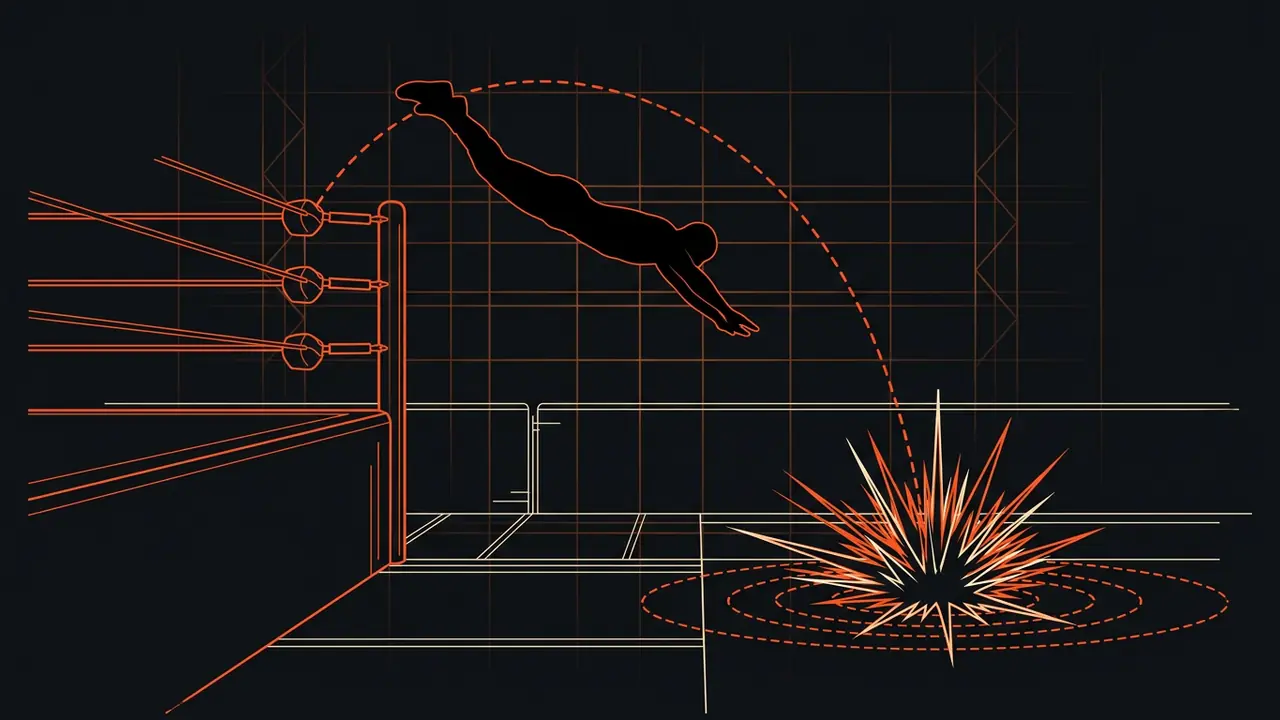
Aerial moves are the ones where the attacker leaves the ground on purpose and lets gravity finish the argument. The category runs from a standing moonsault to a dive over the top rope onto a group on the floor. What ties them together is not height but a shared set of mechanics: a rotation family, a launch, and a receiver who decides how the landing looks.
Rotation families
Almost every aerial in a modern ring belongs to one of three rotation families. The front flip carries the attacker forward over their own chest. The back flip carries them backward. The corkscrew layers a twist onto either one. Once you can name the family, the rest of the move is detail. The moves sit inside a longer story, which pro wrestling history follows from the carnival era forward.
Front flips read as aggressive because the attacker faces the target the whole way down. Back flips read as acrobatic because the attacker loses sight of the target at the apex and finds it again on the way out. Neither is harder in the abstract; they fail in different ways.
Counting the rotation
Move names count quarter turns. A standard splash is a single front rotation, and a 450 splash adds a quarter turn so the attacker lands face down across the opponent. On the back side, a moonsault is one backward rotation off the ropes, while a shooting star press is a backflip performed with the body extended flat, so the attacker travels forward while rotating backward.
- Front flip — forward rotation, attacker keeps eyes on the target.
- Back flip — backward rotation, brief blind spot at the apex.
- Corkscrew — a half or full twist layered onto either rotation.
Dives to the floor
Dives are the riskiest routine in the aerial catalog because the landing surface is the arena floor. There is no give, no apron to slide across, and no rope to grab if the timing goes wrong. The attacker is committed the moment they leave their feet.
The common dives
A suicide dive sends the attacker through the ropes shoulder-first into a standing opponent. A plancha is a horizontal splash over the top rope. A tope con hilo adds a flip on the way out so the attacker comes down on their back rather than their chest. In every case the receiver is already standing on the floor, waiting, which is the part that makes the move survivable.
Springboard and rope-assisted moves
Springboards use the ring itself as a launch pad. The attacker steps on the middle or top rope, lets it stretch, and rides the rebound into the move, buying height without a running start. The technique travels well between styles, and traces how these rope-assisted spots moved between regional promotions before settling into the modern vocabulary.
Rope-assisted moves differ from springboards in one respect: the rope is a walking surface rather than a trampoline. Walking the top rope, balancing on the middle rope for a rebound, and using the turnbuckle as a platform all belong here. The common failure is a rope that gives more than expected, which throws off the rotation count.
| Move | Family | What it does |
|---|---|---|
| Moonsault | Back flip | Backward rotation off the ropes, landing chest-first on a grounded opponent. |
| Shooting star press | Back flip | Body extended flat, attacker travels forward while rotating backward, lands back-first. |
| 450 splash | Front flip | One and a quarter front rotations, landing face down across the opponent. |
| Phoenix splash | Corkscrew | Twisting version of the shooting star, adding rotation to the flat backflip. |
| Corkscrew splash | Corkscrew | Front flip with a half twist, landing with the side or back to the target. |
| Suicide dive | Dive | Attacker exits between the ropes shoulder-first onto a standing opponent on the floor. |
| Tope con hilo | Dive | Flip over the top rope into a dive, landing on the attacker's back. |
| Springboard crossbody | Springboard | Rebound off the ropes into a horizontal body block. |
| Spanish fly | Back flip | Attacker on the top rope flips backward, taking the opponent over in the same rotation. |
The catch
Almost every aerial move is a two-person stunt, and the person receiving it does most of the work. They set their feet, call the timing, and decide where the attacker lands. A dive that looks brutal on television is usually a receiver taking a hard bump on a forgiving part of the floor while the attacker's momentum is absorbed rather than stopped.
What the receiver actually does
The receiver watches the attacker's hips, not their face, because the hips tell you where the rotation will finish. They position their hands to catch a torso or a head before it reaches the mat. And they take the impact on their back, shoulders, or the flat of their forearms, which is why the bump looks worse than it feels.
A missed catch is usually a timing error rather than a strength error. If the attacker arrives a beat early, the receiver has no time to set. A beat late, and the attacker has already started reaching for the mat.
Crowd positioning
Aerial moves are staged for the camera as much as for the live crowd. Wrestlers orient so the arc of the move faces the hard camera, which often means the attacker's back is to the audience on the opposite side of the building. On a dive, the receiver stands so the flight path crosses the frame instead of coming straight at the lens.
The referee's position matters too. A referee who stands too close blocks the shot; one who stands too far away cannot get to the pin quickly. Good positioning is invisible. The crowd sees the move, not the traffic management around it.