Moves in lucha libre
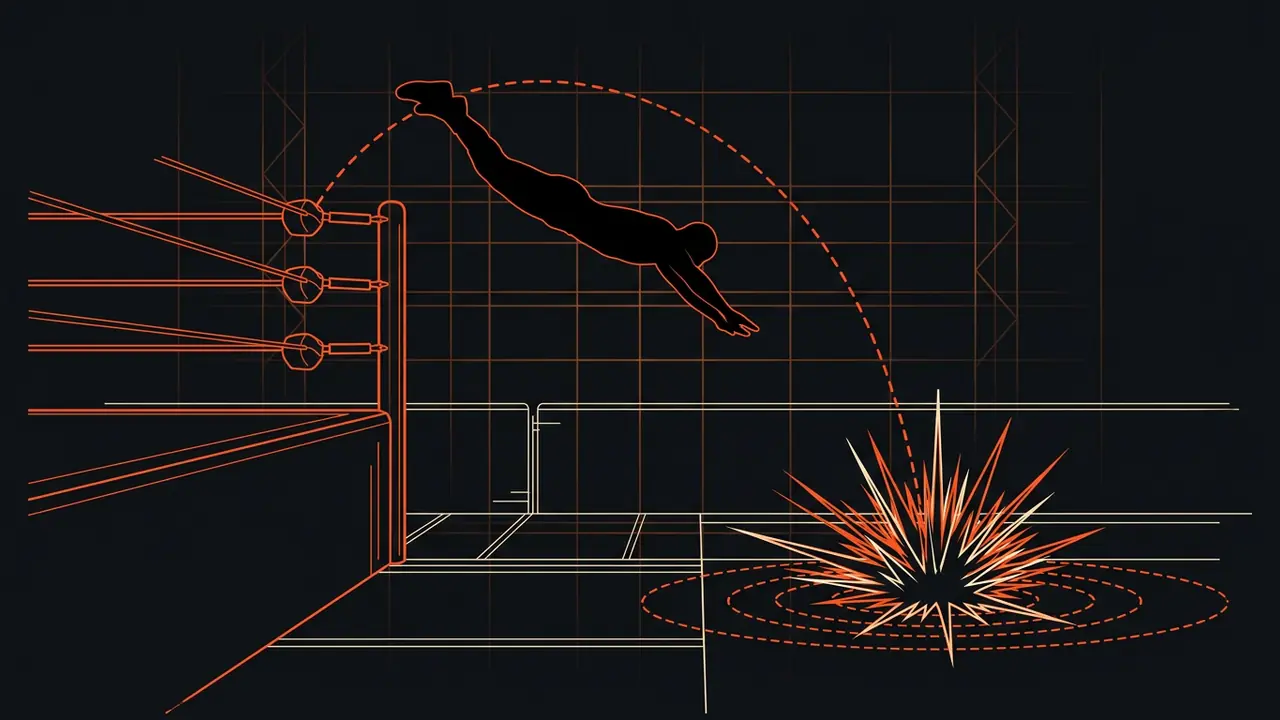
Lucha libre moves are easier to learn as families than as a list of names. The aerial work gets the attention, but the vocabulary around it—topes, planchas, huracanranas, trios sequences—is what lets a viewer describe what just happened. The names matter because they tell you where the move starts, how the body rotates, and whether the point is impact or momentum.
The aerial tradition
Height is the default in lucha libre because the ropes are treated as part of the move, not just the boundary of the ring. A wrestler who stays on the mat is not doing anything wrong; the style simply expects the rope to be used as a launch point, a rebound surface, or a setup for an exit. That habit makes the aerial vocabulary unusually rich. The moves sit inside a longer story, which pro wrestling history follows from the carnival era forward.
The emphasis is not only about spectacular dives. It is also about timing and sacrifice: the attacker leaves the ring, the opponent has to be in the right place, and the landing has to be controlled enough to keep the sequence going. The best aerial workers make that look less like a stunt and more like a routine exchange.
- Rope work — springboards, rebounds, and rope-walks turn the ring into a launch pad.
- Body position — the difference between a plancha and a tope is often the angle of the body, not the height.
- Sacrifice — the dive is a risk for both wrestlers, and the crowd reads that risk.
Topes and dives
A tope is the broad family of attacks that send a wrestler through or over the ropes to the outside. The most familiar is the tope suicida, a running dive through the ropes that turns the attacker into a projectile. A plancha is the body-splash cousin: less a spear and more a full-body drop over the top rope.
The names are not perfectly consistent across regions or promotions, and English commentary often flattens them into “dive.” In Spanish-language usage, the distinction between a tope, a plancha, and a suicida is useful because it tells you what the attacker is leading with. For a broader account of how these exits became central to the style, see.
The exit is the move
Watch the feet first. A wrestler who leaves feet-first is usually aiming for a splash or a crossbody; a wrestler who leaves head-first is usually aiming for a tope. The rotation comes next. A plain dive travels straight; a twisting dive, often called a tornillo, adds a screw before impact. The landing is the last cue: a clean dive ends with the attacker rolling away or landing on top, while a mistimed one ends with both wrestlers down.
Hurracanranas and tilt-a-whirls
The huracanrana—usually spelled hurricanrana in English—is a headscissors takeover. The attacker locks the legs around the opponent’s head or neck, uses the opponent’s own momentum, and pulls them over into a pinning position. It is not a slam. The move works because the attacker never has to lift the opponent; they only have to redirect them.
The tilt-a-whirl is not a move by itself. It is a lift: the attacker spins the opponent around the body, usually by the waist or legs, and the spin creates the opening for a headscissors, a DDT, or a powerbomb counter. In lucha libre, the tilt-a-whirl headscissors is the common payoff, and it is one of the clearest examples of the style’s logic. The smaller wrestler does not need to overpower the bigger one; they need to keep the bigger one moving.
Trios sequences
Trios matches—three-person teams, usually contested as six-man tags—are the standard vehicle for lucha libre’s most elaborate sequences. The format gives wrestlers room for team saves, rapid tags, and the kind of multi-person choreography that is hard to build in a singles match. A trios sequence is not just three singles moves in a row; it is a chain in which each wrestler clears space for the next.
The three-beat pattern
Most trios sequences follow a simple rhythm. First, one wrestler clears the ring or takes out a partner. Second, a second wrestler follows with a dive or a strike to keep the opposition from recovering. Third, the third wrestler—often the base or the smallest member of the team—lands the finishing beat. The pattern is cooperative, but it is presented as competition: the wrestlers are supposed to be stopping each other, not helping each other.
The best sequences also use the referee and the ropes as part of the timing. A tag can be delayed, a dive can be cut off, and a partner can be pulled out of the way. Those small interruptions are what make the choreography feel like a match rather than a routine.
What crossed into the mainstream
The huracanrana is now a staple in almost every promotion, and the tilt-a-whirl headscissors is close behind. The tope suicida and the plancha are no longer specialty acts; they are standard ways to start a big match or swing a tag. The springboard moonsault and the corkscrew dive have also become common enough that audiences expect them from high-flyers.
What crossed over is not just the moves but the logic behind them. Mainstream wrestling now accepts that a smaller wrestler can use momentum instead of power, and that a dive to the outside can be a believable near-fall setup. The vocabulary is still lucha libre’s, even when the match is not.
| Move | Family | What it does |
|---|---|---|
| Tope suicida | Dives | Running dive through the ropes to an opponent outside |
| Plancha | Dives | Body splash over the top rope to the floor |
| Huracanrana | Headscissors | Headscissors takeover that pulls the opponent into a pin |
| Tilt-a-whirl headscissors | Headscissors | Uses a spinning lift to set up a headscissors takeover |
| Springboard moonsault | Aerial | Backflip splash launched from the ropes |
| Corkscrew plancha | Dives | Rotating splash over the ropes with a twisting axis |
| Tornillo | Aerial | Twisting dive or moonsault with a screw rotation |
| Asai moonsault | Aerial | Moonsault to the outside onto a standing or draped opponent |
For a beginner, the useful habit is to name the family first and the move second. A dive is a dive before it is a specific dive. A headscissors is a headscissors before it is a huracanrana. Once the family is clear, the Spanish names stop sounding like a private code and start working as a practical shorthand for what is happening between the ropes.