Wrestling moves: frequently asked questions
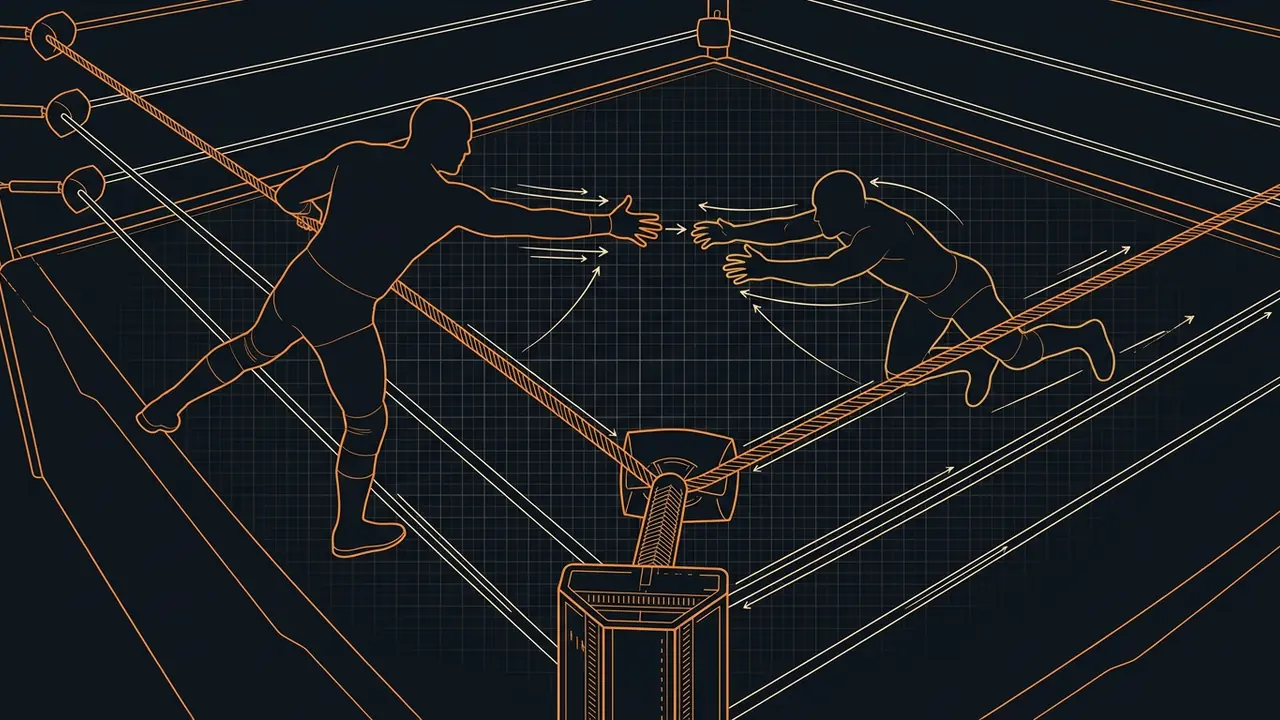
Most wrestling questions are really vocabulary questions. A fan sees a body go up, come down, and the crowd react, and wants to know what to call it and whether it hurt. The answers are usually simpler than the spectacle suggests — and more interesting. What follows covers the questions that come up most often, in plain terms.
What is the hardest wrestling move to take
There is no single answer, and anyone who gives you one is guessing. Difficulty depends on the taker, the giver, the size difference, and how much of the fall the person landing can control. The moves performers dread most are the ones with the smallest margin for error: anything where the head and neck are the landing surface, or where the taker is dropped from height and cannot see the mat. The wider context is traced era by era in pro wrestling history.
A move that is routine in one set of hands is genuinely frightening in another. Veterans tend to describe the hardest move to take as the one being delivered by someone they do not trust.
What makes a move risky to take?
Height, landing surface, and control. A taker who can see the mat and adjust mid-fall is in far less danger than one who is inverted, blind, and waiting for a catch. The giver's ability to stop the move halfway matters as much as the move itself.
Do wrestlers practice big moves before using them?
Yes, in training and again in the ring before the doors open. Rehearsing on the actual canvas, with the actual ropes and the actual partner, is standard practice for anything with a high degree of difficulty.
Why do wrestlers slap their thigh
The slap is a sound effect. When a performer throws a kick, the hand striking the thigh produces a sharp crack that reads as impact to the audience, especially in a large building where the visual is distant. The noise does the work that a pulled strike cannot.
It is not a substitute for contact so much as an addition to it. The leg is struck, the sound carries, and the crowd hears the hit as much as it sees it.
Why does the thigh slap sound so loud on television?
Ring microphones are placed to pick up exactly this kind of sound, and broadcast audio is mixed to emphasize it. In the building the slap is audible; on a screen it can sound like a gunshot.
Are wrestling moves real
The moves are worked, which is not the same as fake. Two performers cooperate to produce something that looks like a fight, and the outcome is planned in advance. The impact is real, though — bodies hit the mat, chops land, and the soreness the next morning is not scripted.
The honest framing is that the cooperation is genuine and the damage is controlled. That control is a skill, and it is the reason the work looks convincing. The distinction has a long history, and traces how the craft and its vocabulary developed.
Do wrestlers actually hit each other?
Sometimes, and deliberately. Punches are usually pulled or aimed past the head, but chops, forearms, and kicks are often delivered with real force because the sound and the red mark are part of the show. Strikes to the head are treated far more carefully than they once were.
Why do the strikes look like they miss?
Because a strike that visibly lands risks a concussion or a broken jaw. Working close and turning the head sells the hit while keeping the actual contact light, and the camera angle hides the gap.
What is a finisher
A finisher is the move a performer uses to end a match, and it is protected so the audience reads it as decisive. Protection means opponents almost never kick out of it, which makes the rare escape a major story beat. The payoff is anticipation: the crowd knows the match is over the moment the move is set up.
Why do wrestlers sometimes kick out of a finisher?
Because the moment is worth more than the move. A kickout at a major event tells the audience that this opponent is exceptional, and it raises the stakes for the rematch. Used too often, it dulls the finisher's value.
Can a wrestler use someone else's finisher?
They can, and it usually means something. Borrowing an opponent's signature move reads as a taunt or a statement of disrespect, and it rarely ends well for the person doing it.
Why are some moves banned
Promotions restrict moves for two reasons: risk to the performers and risk to the business. A move that reliably causes neck injuries, or that a regulator or insurer has flagged, becomes a liability that no promotion wants on its card. Bans are also a way to keep a dangerous spot rare enough to stay special.
| Move type | Typical reason for restriction |
|---|---|
| Head-drop variations of the piledriver | Neck and spine risk with almost no margin for error |
| Unprotected chair shots to the head | Concussion risk; the hands-up version is now standard |
| High-risk dives to the floor | Landing surface and the difficulty of catching a falling body |
| Spike-style finishing moves | Direct compression of the neck on landing |
Who decides a move is banned?
Usually a combination of the promotion's agents and medical staff, with input from insurers and, in regulated markets, from athletic commissions. The list is not universal — a move legal in one company may be off-limits in another.
Are banned moves ever used anyway?
Rarely, and almost never without approval. When a restricted move does appear, it is usually a one-off that has been cleared in advance, and using one without permission is treated as a disciplinary matter rather than a creative choice.