Top rope moves
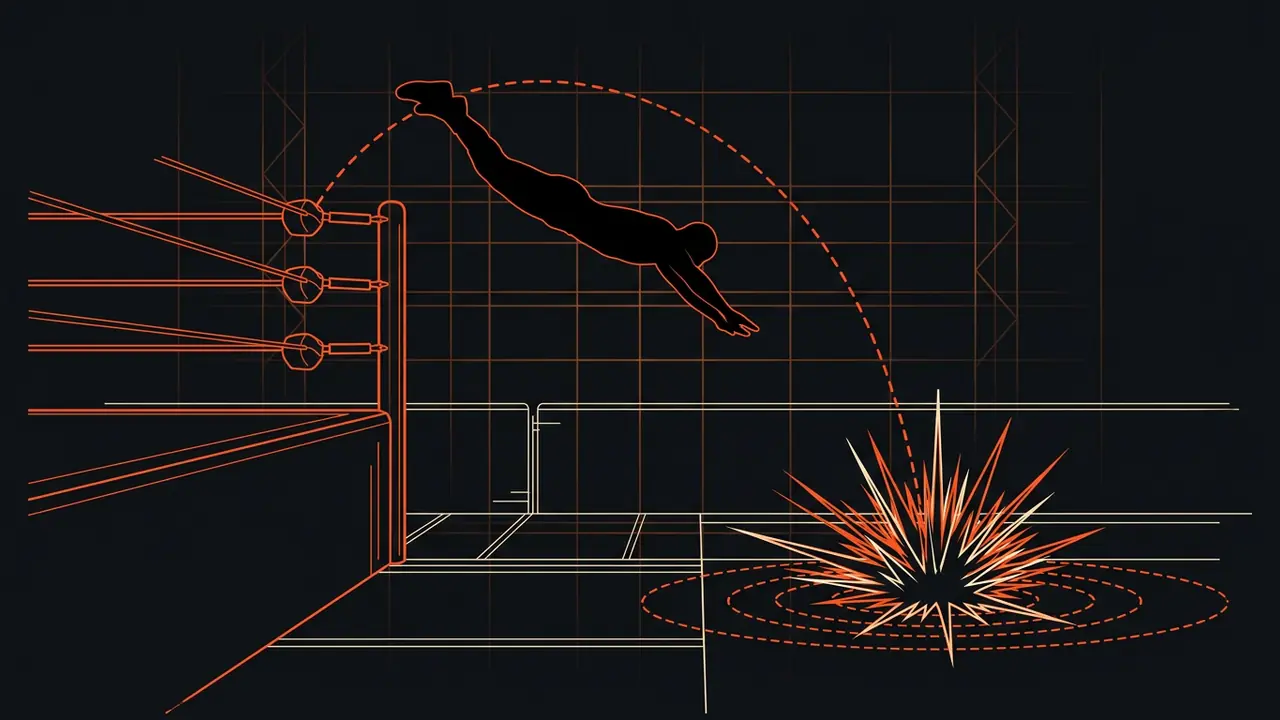
Every top rope move starts the same way: a wrestler climbs the corner, finds footing on the middle or top rope, and pauses. What happens after that pause is where the vocabulary gets specific. A splash, a moonsault and a diving elbow drop all launch from the same perch, but they rotate differently, land differently, and sit in different places on a card.
Naming them correctly comes down to three things: where the attacker launches from, how the body turns in the air, and which part of the body arrives first. Get those right and most of what you see between the ropes becomes describable. How the style travelled between countries is covered in pro wrestling history.
The turnbuckle as a stage
The ring has four corners and only three are usually in play. The hard camera sits at ringside, close to canvas level, so the near corner frames the shot while the far corner reads as distance. A wrestler climbing the far turnbuckle is not just higher up; on screen they are smaller and further away, which changes how the audience reads the risk.
The top rope is a cable under tension, not a platform. It sits closer to a standing wrestler's chest than to the mat, which is why balance matters more than raw height. Watch the feet: experienced workers settle their weight over the ball of the foot and keep one hand free, because the rope gives under load.
Climbing, balancing, and the pause
The pause at the top is not hesitation. It is a cue. It tells the audience where to look, lets the receiver set their feet, and gives the referee a moment to check both wrestlers. Some of the loudest reactions in a match come from a wrestler simply standing still on the second rope.
Splashes and elbow drops
These are the oldest top rope moves in the book and still the most common finishes. A splash lands the attacker's torso across a fallen opponent; an elbow drop arrives point-first. Both are simple, both are legible from the cheap seats, and both can be kicked out of when a story needs them to be.
That is the real distinction between a finish and a transition. The move does not decide it; the booking does. A frog splash that ends a match is a finish. The same frog splash on television, kicked out of at two, is a transition that exists to move the match toward something else.
Common splash variants
- Frog splash — knees tucked, body spread, chest-first landing.
- 450 splash — a full forward rotation and a half, arriving chest-first.
- Senton — back-first, often thrown from the apron rather than the top rope.
- Diving elbow drop — the point of the elbow, usually to the chest or sternum.
Moonsaults from the top
A moonsault is a backflip thrown backward off the rope. The attacker leaves the turnbuckle facing away from the ring, rotates blind, and only picks up the target again as the rotation completes. There is no point in the middle of the move where the landing zone is visible.
That is why the moonsault looks more dangerous than it usually is, and why it depends so heavily on the receiver. The person on the mat is not passive; they are holding a position the attacker has to trust. Readers who want the longer history of how aerial moves traveled between Japan, Mexico and the United States can start with.
Variations change the launch, not the landing. A springboard moonsault uses the ropes as a slingshot; a corkscrew moonsault adds a twist so the attacker arrives sideways. Both keep the same blind rotation at the core.
Double-team top rope spots
Tag wrestling adds a second body to the corner, and the arithmetic changes. One partner holds or positions the opponent while the other climbs. The Doomsday Device, where a diving clothesline meets a wrestler draped across a partner's shoulders, is the clearest example. The illegal partner's job is to keep the target upright and still, then clear out before the referee turns around.
Timing is the whole trick. The climbing wrestler cannot see the setup once they leave the rope, so the partner on the floor is effectively calling the landing. When it works, the sequence reads as one motion; when it does not, it reads as two people arriving at different times.
Landing safely
The receiver controls most of what a top rope move looks like. They feed the attacker a clear target, take the impact across the flat of the back or chest rather than a joint, and absorb it by exhaling on contact. The ring helps — a sprung wooden deck over steel, with canvas and padding on top — but the technique belongs to the wrestler.
Watch a veteran take a splash and you will see them lift their head slightly and turn their face away a beat before impact. Watch a rookie and you will see them brace. The difference is not courage; it is knowing where the attacker's weight is going to land.
Common top rope moves at a glance
| Move | Family | What it does |
|---|---|---|
| Frog splash | Splash | Full body spread across a grounded opponent's chest |
| Diving elbow drop | Elbow drop | Drives the point of the elbow into a fallen opponent |
| Moonsault | Backflip | Backward rotation, landing chest-first on the target |
| Shooting star press | Forward flip | Forward rotation with a back-first landing |
| Diving hurricanrana | Headscissors | Snaps the opponent over with the legs into a pinning position |
| Top rope crossbody | Flying body attack | Throws the whole body across, often as a transition |
| Superplex | Suplex | Both wrestlers fall from the top rope, back-first |
| Diving double axe handle | Axe handle | Fists together, swung down onto the head or back |
None of these are rare, and none of them are as reckless as they look. The height is modest, the rotation is rehearsed, and the person underneath is doing as much of the work as the person in the air.