Move safety and taking a bump
A bump is a fall you agree to take. The audience sees a body hit the mat; what actually happens is a short sequence of decisions — where the chin goes, where the arms go, when the air leaves the lungs — made in well under a second and repeated hundreds of times a year. Learning how to take a bump is the first physical skill any trainee is taught, and it is the one they will still be refining a decade later.
The flat back bump
The foundational move is the flat back bump, and it is taught before almost anything else. The taker tucks the chin hard toward the chest, spreads the arms out to the sides, and lands across the upper back and shoulders rather than on the hips or the lower spine. The head never touches. The legs come up off the mat on impact, carrying off the rest of the momentum. The longer story of how these styles developed is covered in pro wrestling history.
The arms do two jobs at once. They keep the elbows from catching the mat and taking the weight on a joint, and they slap down flat on either side of the body at the moment of impact. That slap is where the familiar crack comes from. It sounds like a body hitting hard because it is a body hitting hard — but the sound is spread across a wide, flat surface instead of concentrated in one spot.
Chin, arms, and the habit that sticks
Coaches drill the chin tuck until it is automatic, because the failure mode is ugly. A taker who lets the head snap back on a back bump is asking for the base of the skull to meet the canvas and the neck to absorb whatever comes next. Beginners also tend to reach backward with the hands, which puts the wrists and elbows under the body. Arms out, palms down, is the correction.
The same mechanics run through most of the move set. Different moves change the angle of arrival, the height, and how much control the taker has, but the landing principles stay consistent.
| Move | Family | What it does |
|---|---|---|
| Bodyslam | Throw | Taker is lifted, held horizontal, and dropped flat across the upper back. |
| Vertical suplex | Throw | Taker goes over the attacker's head and lands on the back and shoulders. |
| Back body drop | Throw | Taker is flipped over the attacker's back, landing on the upper back. |
| Hip toss | Throw | Taker is rotated over the hip and lands flat on the back. |
| DDT | Impact | Taker's head is tucked under the attacker's arm and both drop, taker landing face down. |
| Dropkick | Strike | Taker takes two boots to the chest or face and falls backward. |
| Superkick | Strike | Kick to the jaw; taker falls backward or to the side. |
| Moonsault | Aerial | Attacker backflips off the top rope onto a downed opponent. |
| Plancha | Aerial | Attacker dives over the ropes onto an opponent on the floor. |
The canvas and the give
A wrestling ring is not a trampoline, and it is not a concrete floor with fabric over it. The typical ring is a steel frame with cross members, wooden planks laid across them, a layer of foam, and a canvas stretched and laced tight over the top. The planks flex a little under a body. That flex is the give, and it is deliberately modest.
Too much spring and the ring becomes unstable underfoot, which makes every step and every lift less predictable. Too little and the bump stops dead, and the taker's body absorbs everything. Ring builders tune that trade-off, and different promotions land on different answers; a ring that feels right for a heavy, slow main event style can feel stiff to a lighter, faster worker. The longer history of how rings evolved from carnival platforms to television studios is covered in, but the constant is the search for a surface that gives without bouncing.
The floor outside the ring is a separate problem. There is no give on an arena floor, and a bump taken out there is a different calculation from one taken between the ropes. That is why so much of the training around ringside spots is about the landing zone rather than the move itself.
Breath and landing
The mistake beginners make most often is holding their breath. A taker who inhales and locks up goes into the mat rigid, and a rigid body takes the impact all at once. Exhaling through the landing — a short, audible breath out — relaxes the trunk and lets the back spread the force. It also reduces the chance of getting the wind knocked out.
Falling versus jumping
There is a related habit that takes longer to fix. New trainees jump into bumps, adding height and energy the move does not need. The taker's job is to fall, not to launch. The attacker supplies the lift and the direction; the taker supplies the rotation and the landing. When both people add force, the bump gets bigger than either of them planned for.
Timing matters as much as shape. The taker has to be moving with the move, not waiting to be moved, and that means committing to the fall slightly before the attacker's hands arrive. Hesitation is what turns a routine bump into a clumsy one.
High-risk moves and the margin
Most bumps have margin. A back bump from a hip toss can be a few inches off and still be fine. Some moves have almost none, because the taker's head or neck is in the landing path and the attacker's control is limited by the move's own geometry. Piledrivers, certain suplex variations, and anything where a body is dropped from height onto another body sit in that category.
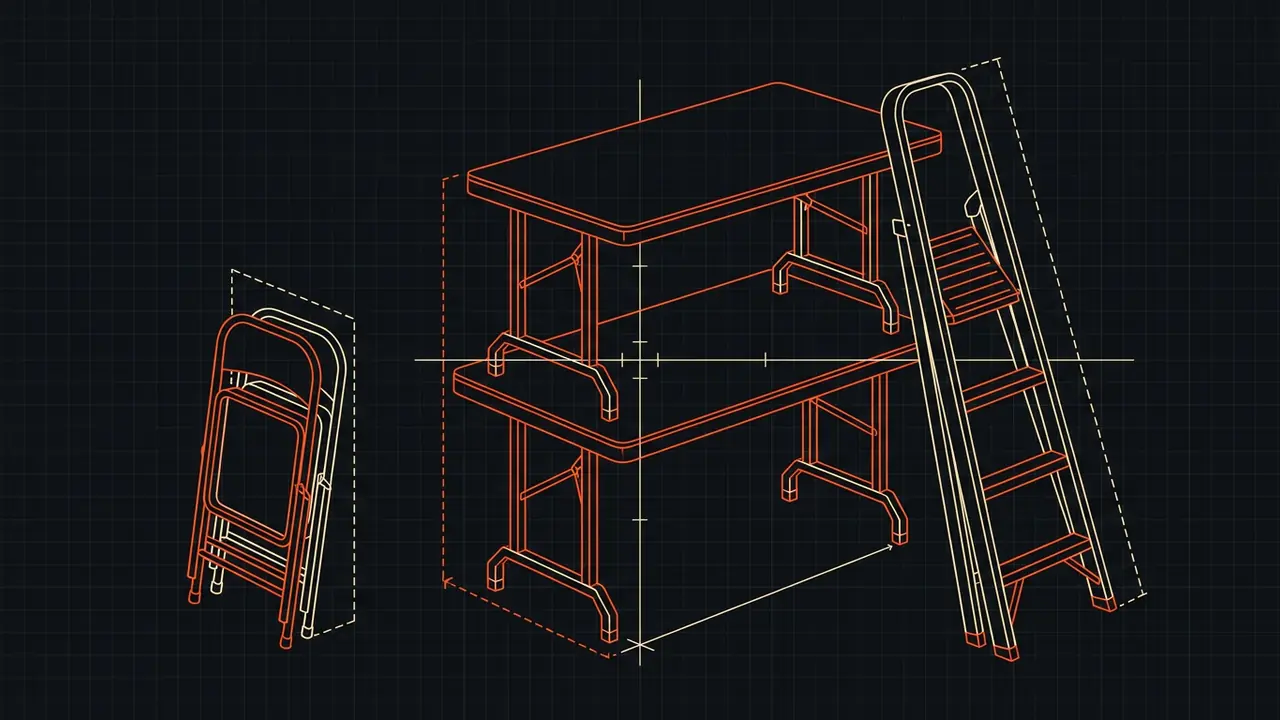
Dives to the floor and ladder or table spots add a second variable: the landing surface. A taker who has rehearsed a fall onto a padded mat is now falling onto a thinner pad, or onto a table built to break in a particular place. The margin narrows again.
What goes wrong is usually timing, not intent. A fraction of a second early or late and the taker's hands are not where they need to be, or the attacker's grip slips, or the taker rotates too far and lands on a shoulder instead of the back. Referees and agents watch for it, and the check after a bad landing is a real part of the job rather than a courtesy.
Long-term damage
Nobody leaves this work with the same body they started with. Knees take the cumulative load of thousands of landings and of the squat-and-lift position that throwing requires. Backs accumulate the smaller, imperfect bumps — the ones taken slightly wrong at the end of a long night. Necks carry the cervical spine's share of every near-miss.
What the wear looks like
The pattern is degenerative rather than dramatic: arthritis in the knees and hips, compressed discs in the lower back, reduced range of motion in the neck. Concussions are their own category, and the repeated sub-concussive impacts of a bump-heavy style are now treated as a genuine concern rather than a badge of toughness. Veterans describe the daily maintenance — stretching, icing, taping — as part of the job rather than recovery from it.
- Land on the upper back and shoulders, never the hips or the head.
- Chin tucked, arms out and flat, palms down.
- Exhale through the landing; do not hold the breath.
- Fall into the move rather than jumping into it.
- Check the landing surface before any ringside or floor spot.