How wrestling moves evolved
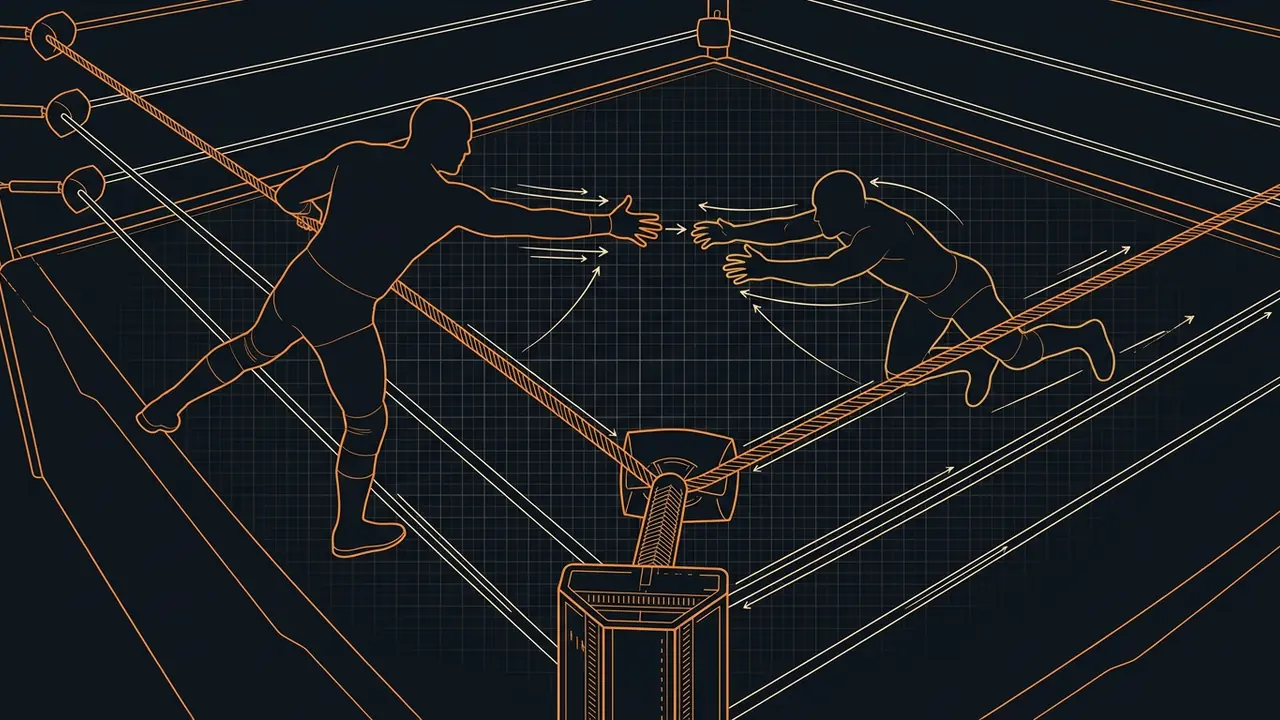
Every move has a paper trail. The history of wrestling moves is less a catalog of inventions than a record of technique moving between countries, getting renamed, and coming back changed. Trace the traffic and the modern move set stops looking like a random pile of flips and starts looking like a family tree.
The catch base
Catch-as-catch-can was a legitimate competitive style, and its vocabulary was built for a fight that had to be won. A hook was not a flashy hold; it was a controlling grip that stopped an opponent from escaping while a submission was applied. Lancashire catch wrestlers in Britain and Ireland, and the American shooters who learned from them, treated the body as a set of locks and levers. For why the style changed when it did, see pro wrestling history.
That logic still sits under everything. When a modern wrestler grapevines a leg or traps an arm before a finish, they are using a grammar that predates costumes and entrance music. The moves changed; the purpose of control did not.
Control before impact
The catch tradition sorted offense by what it did to an opponent's ability to continue. Joint locks attacked a single limb. Neck cranks threatened the spine. Rides kept a man flat while the referee counted. Modern wrestling keeps that taxonomy even where the stakes are scripted.
- Hooks — controlling holds that stop an opponent from escaping while a submission is applied.
- Rides — top-position control, later folded into pinning combinations.
- Takedowns — the throws and trips that became the modern suplex family.
Carnival showmanship
When catch moved into carnivals, fairgrounds, and athletic clubs, the match became a performance with a paying crowd. A wrestler needed moves the back row could read instantly: a big lift, a long hold, a dramatic escape. The worked match did not abandon technique; it reorganized technique around visible stakes.
Showmanship added what competition had no use for — the setup, the pause before the finish, the repeated spot a crowd learns to anticipate. Moves became sentences in a story rather than solutions to a problem. The stall, the strut, and the long rest hold all came from the same instinct: give the audience something to react to.
Japanese refinement
Postwar Japanese wrestling took the catch curriculum seriously and built institutions around it. Karl Gotch's teaching shaped a generation of wrestlers, and promotions such as New Japan and All Japan turned technique into a discipline with grades and hierarchies. Precision mattered because the audience was trained to notice it.
Naming became part of the craft. A bridging German suplex is not just a suplex; it is a hold with a name, a practitioner, and a lineage. The wider story of how promotions codified that knowledge is covered in, which follows the institutional side of the same arc.
Why names matter
Distinct names let a wrestler claim a move as property. Mitsuharu Misawa's Emerald Flowsion, Kenta Kobashi's Burning Hammer, and Toshiaki Kawada's Ganso Powerbomb differ from a standard version less in mechanics than in authorship. Naming also let fans compare: calling something a backdrop hold tells you the bridge is the point.
Mexican aerial influence
Lucha libre developed a separate answer to the same problem: how to make a fall legible from the cheap seats. Mexican wrestling leaned on height, rotation, and the mask as a storytelling device. The dive off the top rope and the headfirst tope through the ropes became signatures of a style built on momentum rather than control.
The rana, a headscissors takeover, and its flying version, the hurricanrana, are the clearest exports. When lighter Mexican and Mexican-American wrestlers reached U.S. television in the 1990s, they brought a tempo that changed what a cruiserweight match could look like. Heavier wrestlers soon borrowed the same rotations, and the dive stopped being a specialty. Tag and trios matches gave those dives a structure, letting a team build a sequence of rotations before the finish.
The modern hybrid
Today's move set merges all four streams, and the merge accelerated once matches circulated on tape and then online. A wrestler can train in a Japanese dojo, work a Mexican tour, and study British catch footage in the same year. Nothing stays local for long.
The result is a vocabulary where a strike, a submission, and a flip can sit in the same sequence without friction. Women's wrestling, particularly the Japanese joshi tradition, pushed that blending further by treating stiffness and aerial work as compatible rather than opposed.
The trade-off is sameness. A tope is no longer a Mexican exclusive, and a cross armbreaker shows up in every promotion on the planet. The table below sorts a few common moves by the tradition that shaped them most.
| Move | Family | What it does |
|---|---|---|
| German suplex | Suplex | Lifts the opponent backward from a waist lock and bridges into a pin. |
| Hurricanrana | Aerial / rana | Scissors the head and rotates the opponent over into a pinning position. |
| Tope suicida | Dive | Sends the attacker headfirst through the ropes onto a standing opponent. |
| Cross armbreaker | Submission | Isolates the arm and hyperextends the elbow from a supine position. |
| Powerbomb | Power | Lifts the opponent and drops them onto the back or shoulders. |
| DDT | Impact | Applies a front headlock and drives the opponent's head down. |
| Moonsault | Aerial | Backflips off the ropes or turnbuckle onto a downed opponent. |
| Sharpshooter | Submission | Traps the legs and bends the lower back. |
| Superkick | Strike | A straight kick to the jaw, usually from a standing exchange. |
None of these labels are fixed. A move's family tells you where it came from, not where it will end up next. That is the useful part of the history: it gives you a way to name what you are watching, and a reason to notice when something new arrives.