Tag team moves
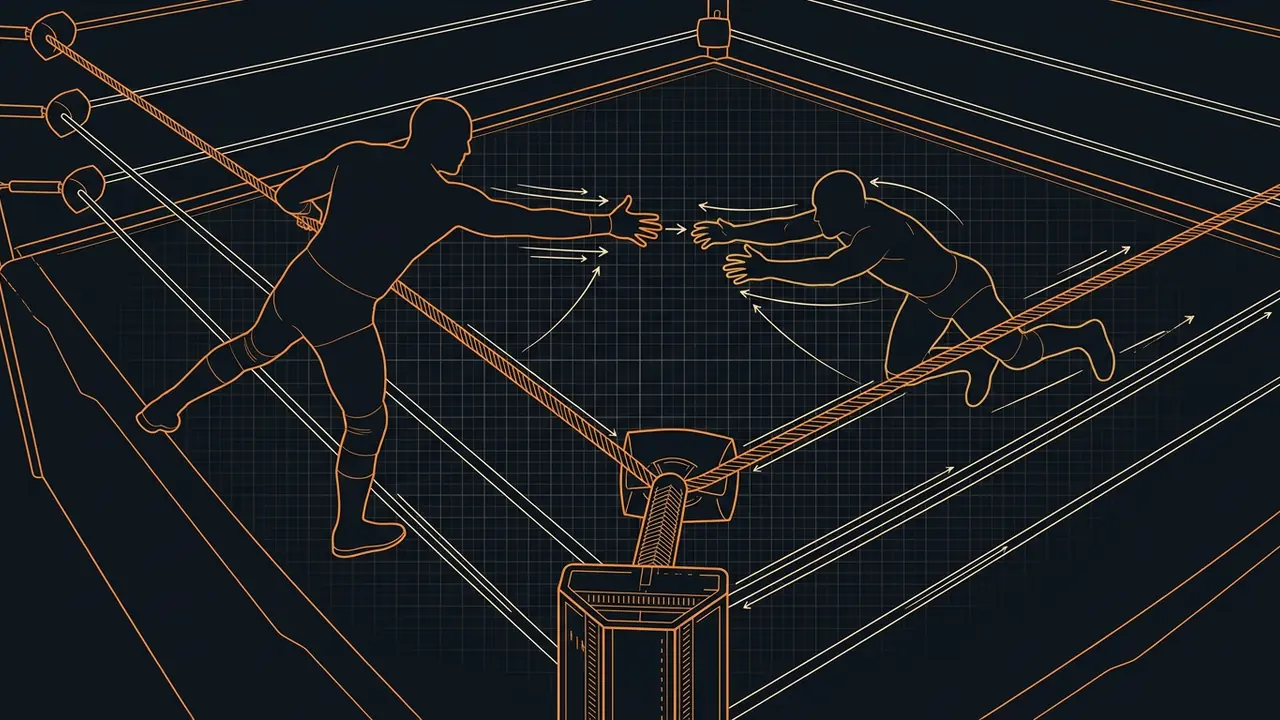
Tag team wrestling looks chaotic because the chaos is carefully managed. The moves are only half the story; the other half is the legal-man structure that decides who can be in the ring, when a save is allowed, and why a referee turns around at the worst possible moment. Learning the vocabulary of tag team moves starts with that structure, not with the highlight reel.
The legal man rule
The legal man rule is the spine of every tag match. Each team keeps one wrestler in the ring as the legal man, and the partner waits on the apron until a tag is made in their corner. The referee watches for that tag and keeps the illegal partner out, which is why so much tag team wrestling happens at the edge of the referee's vision. How the style travelled between countries is covered in pro wrestling history.
Why the corner matters
The corner is not just a home base. It is the only place where a tag can be made, so teams fight over distance and angle. Cut the ring in half, keep one wrestler away from his partner, and the tag becomes a prize rather than a formality.
That structure gives every double-team move a purpose. A tag team can isolate a limb, switch without warning, or bait the referee into watching the wrong corner. The legal man rule is what turns two separate wrestlers into a unit with a plan.
Double-team moves
Double-team moves are the vocabulary fans usually mean when they say tag team moves. The power-and-plex family covers the most common shapes: one partner lifts, the other strikes; one holds, the other runs; one suplexes, the other cuts off the escape. The label is broad, but the logic is consistent, because every double-team move is built around a base wrestler and an assisting wrestler.
Power moves and suplex variants
In the power-and-plex family, the base wrestler controls the opponent's body while the assisting partner adds force or removes a defense. A double suplex needs both wrestlers to lift on the same beat. An assisted powerslam needs the second wrestler to arrive after the opponent is already off the ground, not before. The difference between a clean move and a clumsy one is usually a half-step of timing.
Not every double-team move is a power move. Some are aerial, some are strikes, and some are simply two wrestlers cutting off the ring together. The table below groups the common examples by family so the next match is easier to call. For a broader look at how these sequences became standard across promotions, see.
| Move | Family | What it does |
|---|---|---|
| Double suplex | Suplex | Two wrestlers lift one opponent and take him over together. |
| Assisted powerslam | Power | One partner holds the opponent across the shoulders while the other adds force or cuts off the escape. |
| Doomsday Device | Power and aerial | One partner holds the opponent on the shoulders; the other comes off the top rope with a clothesline. |
| Hart Attack | Power and strike | One partner holds the opponent in a bearhug; the other hits a running clothesline. |
| Demolition Decapitation | Power and strike | One partner drops the opponent across the knee; the other comes off the ropes with an elbow. |
| Poetry in Motion | Aerial | One partner runs at the corner, steps off the partner's back, and lands a senton on the opponent. |
| Double flapjack | Throw | Two partners lift the opponent by the legs and drop him face-first. |
| Wheelbarrow suplex | Suplex | One partner holds the opponent's legs in a wheelbarrow; the other lifts and takes him over. |
| Assisted powerbomb | Power | One partner lifts the opponent; the other steadies or adds impact at the landing. |
| Double clothesline | Strike | Two partners hit a clothesline from opposite sides at the same time. |
The hot tag
The hot tag is the release valve of tag team wrestling. One wrestler absorbs the beating, the partner waits on the apron, and the crowd waits for the moment when the isolated wrestler finally reaches the corner. The tag itself is simple; the work is in making the audience want it.
Building the comeback
A hot tag only lands if the delay has been earned. The isolated wrestler sells exhaustion, the partner reaches with an outstretched hand, and the referee checks the tag while the opposing team tries to pull the partner away. The pop comes from the near miss as much as the contact. When the tag finally happens, the fresh partner clears the ring and the match resets.
The hot tag also changes the referee's job. The official has to see the tag, count the illegal wrestler out, and avoid being pulled into the corner by the opposing team. A good hot tag sequence uses all three responsibilities at once.
Referee distraction spots
Referee distraction spots are the cheap heat of tag wrestling. One partner draws the referee's attention while the other bends the rules, and the audience sees the injustice even when the official does not. The spot is old, but it remains useful because it turns the referee into part of the match without making the referee the story.
The referee's blind spot
The spot depends on positioning. The referee must be physically turned away or occupied, and the illegal partner must be close enough to interfere and far enough to escape blame. A distraction that happens in plain sight is just a mistake; a distraction that happens behind the referee's back is a tactic. Common versions include:
- Arguing on the apron while the partner uses the ropes for leverage.
- Pulling the referee aside as the illegal wrestler enters the ring.
- Holding an opponent's leg from outside so a pinfall is broken.
- Stealing a tag behind the referee's back to avoid a fresh opponent.
- Occupying the referee at the ropes while the partner double-teams in the corner.
These spots are not random. They are a small economy of attention: the referee has one set of eyes, and both teams are trying to spend that attention where it helps them.
Why tag moves need timing
Tag team moves need timing because two bodies have to arrive as one. A double-team move is a small piece of choreography: the base wrestler controls the opponent, the assisting wrestler times the strike, and the referee has to be in a position to see or miss it. When the timing slips, the move reads as a collision rather than a finish.
Two bodies, one landing
The best double-team work hides the setup in motion. The assisting wrestler does not wait for a signal; he reads the base wrestler's balance and moves on the same beat. That is why a good tag team can make a simple double clothesline look like a car crash and a complicated suplex look effortless.
Timing also protects the story. A hot tag, a distraction spot, and a double-team finish all depend on the referee being in the right place at the right time. The legal man rule sets the boundaries, the double-team moves fill the space, and the timing makes the whole thing believable.