How wrestling moves get their names
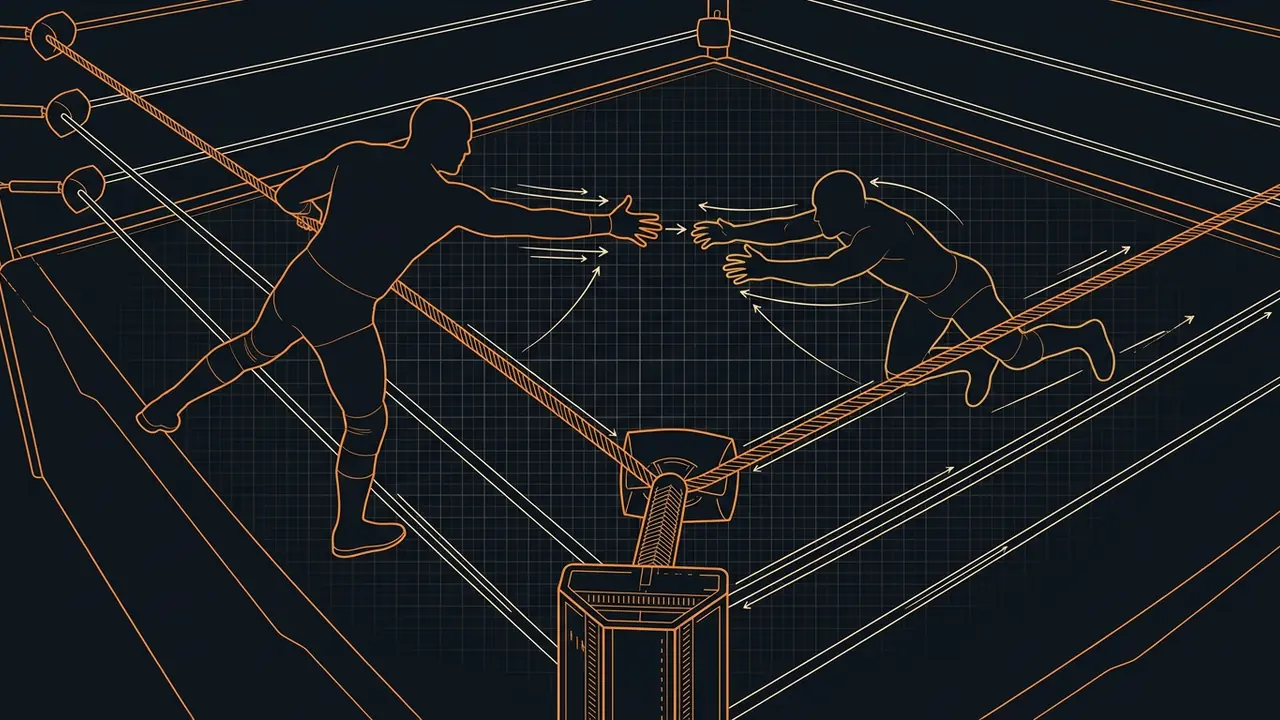
Ask three fans what to call the same throw and you will get three answers, none of them wrong. Wrestling move names are not one system but a stack of them: nineteenth-century mat vocabulary, Japanese branding, regional slang, and the trademark lawyer's shortlist. Knowing which layer a name comes from is most of the work of naming what you are watching.
Most of the words are older than the business that uses them. That is why a move can feel familiar and foreign at the same time, and why the same maneuver gets sold as a classic in one building and a novelty in the next. For the eras and promotions behind them, see pro wrestling history.
Catch names and the old vocabulary
Catch-as-catch-can wrestling, the Lancashire and American mat sport that professional wrestling grew out of, supplies the bedrock. Arm drag, hip toss, hammerlock, half nelson, body slam, switch, stand-up: these are working terms from a competitive sport, and most of them still describe exactly what they say.
Because so many of them are shared with amateur wrestling, they survived without decoration. A half nelson needs no explanation to anyone who has watched a college match, and that shared vocabulary is part of why the older moves still read as legitimate rather than theatrical.
From the mat to the carnival
Carnival and traveling-show wrestling added a showman's instinct for names that sell the move before it lands. "Piledriver" comes from construction; "clothesline" comes from a washing line strung across a yard. Both stick because the image arrives faster than any description would.
Etymology gets murky past a certain point. "Suplex" is usually traced to the French souplesse, meaning suppleness, which is a useful reminder that the words traveled with the wrestlers rather than staying put.
Japanese naming conventions
Japanese wrestling built a parallel vocabulary and runs two layers at once: a precise description of the mechanics, then a personal brand stamped on top of it.
The descriptive layer often borrows from amateur wrestling, which has deep roots in Japan. What a US broadcast calls a German suplex is a backdrop in Japan, used with the same matter-of-factness that "arm drag" gets in English.
The branded layer is where Japanese naming gets distinctive. Rainmaker, Burning Hammer, Shining Wizard, Destino: each belongs to one wrestler, and each is treated as property in a way the old catch names never were. That trade in terms ran in both directions for decades, and follows the trail in more detail.
Loanwords and the personal brand
Japanese promotions absorb English and Spanish terms freely, then re-export them. A move named in Mexico arrives in Tokyo under a katakana spelling and comes back to the US with a Japanese gloss attached. The result is a vocabulary more international than most fans assume.
Regional differences
The same maneuver carries different names depending on which territory taught it, and the differences are not trivia. They tell you where a wrestler trained and which tapes they grew up on.
- Belly-to-back suplex, German suplex, backdrop. Amateur and older US usage, modern US usage, and Japanese usage for the same throw.
- Suicide dive, tope suicida, tope. The US keeps the English phrase, Mexico uses the Spanish, and Japan and the UK often shorten it to the last word.
- Clothesline, lariat. The US name is domestic and plain; the Japanese name carries the weight of the wrestler who made it a finisher, and English-speaking fans now use both.
- Hurricanrana, rana. The long US name credits a luchador; Mexico uses the plain word for frog.
British wrestling kept its own catch lineage and held on to mat-work terminology longer than the US did. That is why some holds sound old-fashioned in one country and completely current in another.
Naming a finisher
A finisher name is a branding decision before it is anything else. It has to be short enough to chant, distinctive enough to put on a shirt, and specific enough that a company can claim it.
The cutter family is the clearest illustration. The mechanics are the same three-quarter facelock dropped into a neckbreaker; the names are not. A Diamond Cutter and an RKO are one move with different owners, and only one of those names belongs to the company that popularized it.
That is why wrestlers change finisher names when they change companies. The move travels; the name often stays behind with the employer that registered it.
What makes a name survive
Generic descriptions tend to lose to proper nouns. "The running knee" is a description, and descriptions are hard to own. A name attached to a person becomes a brand, and brands get merchandise, video game entries, and crowd chants. The best finisher names are short, slightly odd, and impossible to confuse with anyone else's.
Why names drift
Commentary is the biggest engine of change. A term a commentator repeats for a year becomes the standard term, even if the wrestler calls it something else, and once fans adopt it the shift is effectively permanent.
The internet sped that up and standardized it. Fan wikis and clip channels settle on one name and push it backward onto older footage, so a move performed in 1985 ends up labeled with a term coined in 2005.
Names also drift when a wrestler's version outgrows the original, or when a move crosses a language barrier and picks up a loanword on the way. The vocabulary is not fixed, which is exactly what makes it worth learning.
A short reference helps when you are watching with the sound off. The moves below cover the families most names come from.
| Move | Family | What it does |
|---|---|---|
| Arm drag | Takedown | Pulls the opponent's arm across the body and steps through, taking them to the mat. |
| Dropkick | Strike | Jumps and drives both feet into the opponent's chest or face. |
| German suplex | Suplex | Locks the waist from behind, lifts, and bridges backward to throw the opponent overhead. |
| DDT | Front facelock drop | Drops backward from a front facelock, driving the opponent's head into the mat. |
| Boston crab | Submission | Turns the opponent face-down and bends both knees back to compress the lower spine. |
| Figure-four leglock | Submission | Threads the legs into a figure-four around one of the opponent's legs, torquing the knee. |
| Moonsault | Aerial | A backflip from the top rope, landing across a standing or downed opponent. |
| Powerbomb | Slam | Lifts the opponent onto the shoulders and drops them on their back. |
| Clothesline | Strike | A running arm swung across the opponent's chest or throat. |