Finishing moves
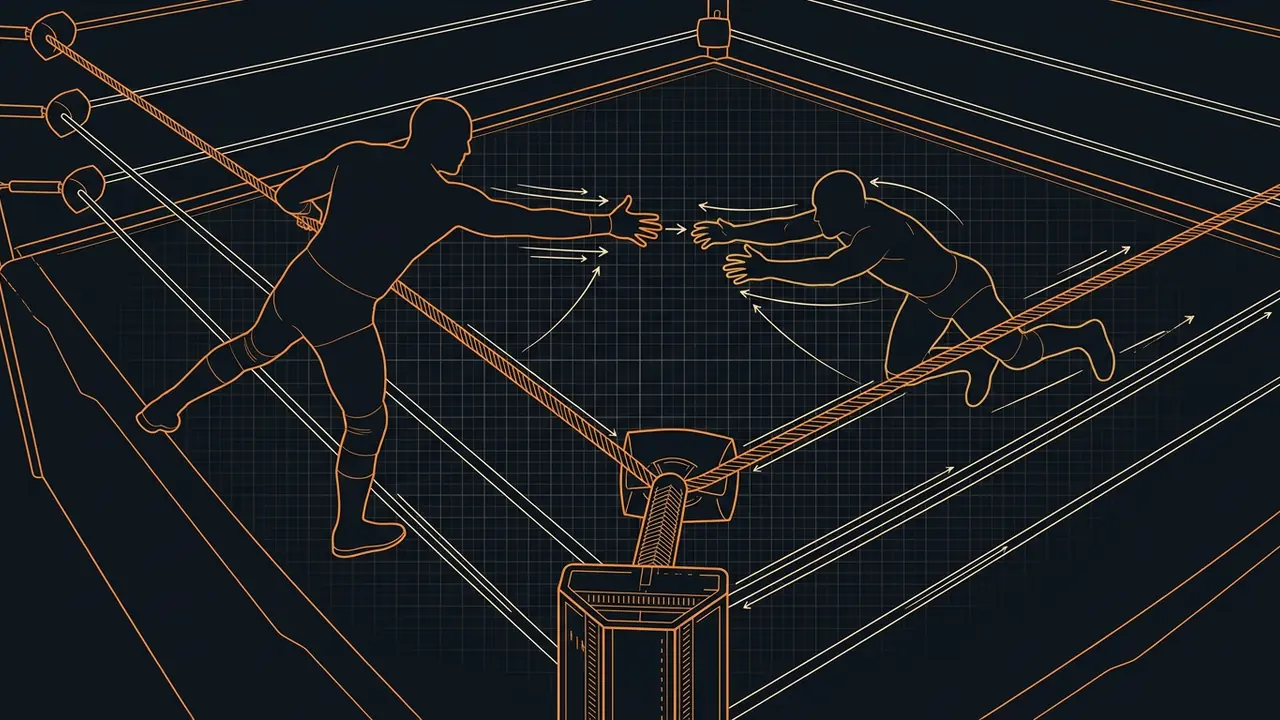
A finishing move is the one thing a wrestler does that is supposed to end the match. Everything else in a bout — the strikes, the holds, the comeback — exists in relation to it. Once you can tell a finisher apart from a signature, most of the storytelling in a match becomes legible, including the parts that look like improvisation.
Signature versus finisher
A signature is a move a wrestler uses often, usually in the same place in the match, and the crowd knows it is coming. It is a calling card, not a promise. A finisher is the move that actually ends matches, and it is booked so that it almost always does. The longer story of how these styles developed is covered in pro wrestling history.
The difference comes down to frequency and meaning. A signature might appear two or three times in a match and produce a near fall, or serve as a setup for something else. A finisher is the last thing the audience sees. When it lands, the referee counts three and the match is over.
Why the distinction matters
The two moves do different jobs. A signature builds anticipation and gives the crowd a repeated beat to react to. A finisher cashes that anticipation in. When a wrestler starts using a signature as a finisher, or a finisher as a signature, the audience reads it as a change in status rather than a change in repertoire.
Protecting the move
Protection is the booking practice of keeping a finisher strong. Nobody kicks out of it — not for months, not for years. Opponents who take it stay down, and the move's credibility is treated as an asset belonging to the wrestler rather than to any single match.
The rule is not absolute, and that is the point. It exists so that breaking it means something. A kickout from a protected finisher is one of the loudest moments a company can produce, and it is spent carefully, usually on a rival being pushed to the same level.
The cost of a kickout
Every kickout spends a little of the move's value. Do it once and the crowd remembers. Do it every week and the move becomes a two-count with extra steps. Protection is really a budget, and the booker is the one keeping the ledger.
The near-fall economy
A near fall is any pin that does not end the match, and the two-count is the basic unit of suspense. The referee's hand comes down twice, the crowd counts along, and the third beat is withheld. The whole apparatus exists to make the final count feel earned.
Near falls are a resource in the same way a finisher is. A match with none feels flat; a match with a dozen in a row feels numbing. The good ones are spaced, escalated, and attached to something the audience already cares about. For the wider history of how matches end, covers the ground this page only sketches.
Reading the count
Watch the referee rather than the wrestlers. A slow count with a hand hovering, a wrestler hooking a leg, a shoulder coming up at two and a half — these are the mechanics of suspense, and they are almost always deliberate.
When a finisher stops working
Finishers age. A move that ended matches cleanly for three years starts to feel like a formality, and the crowd's reaction softens. Sometimes the problem is overexposure: too many kickouts, too many near falls, too many opponents surviving it in the same night.
Sometimes the problem is position on the card. A finisher built for a mid-card act does not always read as a main-event finish, and the move gets quietly devalued before anyone admits it.
- Too many opponents have kicked out of it.
- It has been demoted to a transition move in bigger matches.
- The crowd has stopped counting along with the referee.
- It has been hit and forgotten before the match is over.
Building a new finish
Switching finishers is a booking decision as much as a wrestling one. A wrestler either adopts a new move outright or introduces a variant — a different angle, a different setup, a different target — then spends months establishing it as the thing that ends matches.
The transition is usually messy. The old finisher gets demoted to a signature: still hit, still teased, but no longer the last beat. The new one gets protected from day one, which means winning with it cleanly and often enough that the audience stops expecting the old ending.
The variant route
Variants are the safer play. A modified version of a familiar move keeps the recognition while adding a new finish, and it lets the wrestler keep the old move in the arsenal without confusing anyone. It also gives the commentary something to explain, which is often the point.
For reference, here are common finishes grouped by family. The family tells you what the move is doing to the body; the specific move tells you whose it is.
| Move | Family | What it does |
|---|---|---|
| DDT | Front facelock drop | Drives the opponent's head into the mat from a front facelock |
| Powerbomb | Throw | Lifts the opponent and slams them down on their back |
| Chokeslam | Throw | Lifts by the throat and drives the opponent down |
| Spear | Tackle | Drives a shoulder into the midsection at speed |
| Superkick | Strike | Boot to the jaw from a standing or running position |
| Figure Four Leglock | Submission | Hyperextends the knee and ankle of a grounded opponent |
| Sharpshooter | Submission | Bends the spine backward while trapping the legs |
| Shooting Star Press | Aerial | Backflip splash from the top rope |
| Crossface | Submission | Pulls the head back while cranking the neck and shoulder |
None of these moves ends a match on its own. What ends a match is the months of booking that taught the audience to believe it would.